
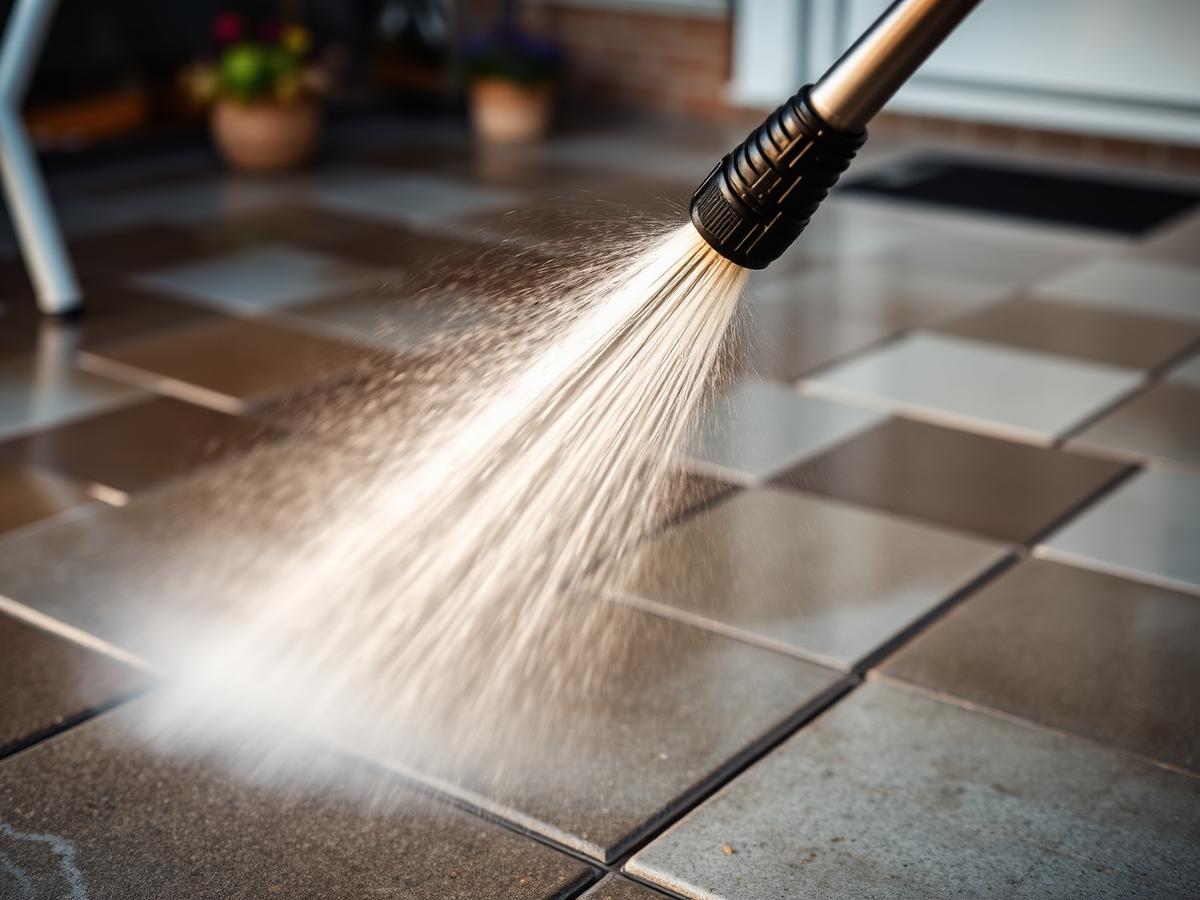
Biocide Treatment for Shaded Patios Near Castleford Country Park
Shaded patio near the country park with persistent black spot
Properties whose gardens back directly onto the country park and surrounding green corridor get more leaf litter, seed drift and shade than most Castleford gardens, and their patios show it. Black spot and green algae establish here faster than on an open, sun-exposed patio elsewhere in town, because the tree canopy keeps the paving damp for days after rain.
Gardens backing onto tree cover and damp ground
Properties whose gardens back directly onto the country park and surrounding green corridor get more leaf litter, seed drift and shade than most Castleford gardens, and their patios show it. Black spot and green algae establish here faster than on an open, sun-exposed patio elsewhere in town, because the tree canopy keeps the paving damp for days after rain.
Sandstone flags are common on these patios, laid when the houses were extended in the past couple of decades, and the porous nature of the stone means spores and algae work into the surface rather than just sitting on top of it. A quick wipe-down or a single pressure pass rarely gets ahead of the regrowth cycle here.
Because these gardens sit close to woodland, they also see more fine organic debris — pollen, sap, leaf mould — settling continuously, which feeds exactly the growth a biocide treatment is designed to knock back at the root.
Getting kit in, getting water away
Rear gardens here typically have narrow side access via a gate shared with next door, so we confirm timing to avoid two properties needing the same passage at once, and garden furniture or planters get moved clear before treatment starts.
Treated run-off from a shaded patio close to woodland often drains toward a soakaway or border bed rather than a formal gully, so biocide dilution and application volume are kept conservative to avoid oversaturating nearby planting.
- Nearest city
- Wakefield — 9 miles
- Typical surfaces
- block paving and imprinted concrete drives
- Common property stock
- red-brick terrace, 1950s semi, modern estate home
- Nearest commercial hub
- Xscape Yorkshire and Junction 32 outlet
- Area type
- industrial town
- Postcode district
- WF10
What shapes a treatment near woodland
Before we start
- Shaded, woodland-adjacent patios regrow algae faster than open ones
- Sandstone porosity varies and affects how much solution is needed
- Nearby borders and planting are protected during application
Once it's done
- Results on black spot show gradually over following weeks
- Garden access via shared side gates needs coordinating in advance
Identifying growth type before treatment
Black spot versus general algae film
We distinguish stubborn black lichen spotting from a general green film, since the two need different concentrations and dwell times.
Stone porosity
Sandstone flags vary in how porous they are batch to batch, so we check absorption before deciding how much solution the surface actually needs.
Surrounding planting proximity
Borders and shrubs close to the patio edge are noted so treatment can be kept off foliage during application.
How the biocide is applied and left to work
- Step 1
Targeted low-pressure application
Biocide is applied with a controlled sprayer rather than a hose, keeping solution on the paving and off nearby planting.
- Step 2
Extended dwell for shaded areas
Given the persistent damp under tree cover, we allow a longer working period before any rinse, since growth here is often more entrenched.
- Step 3
Delayed visible result explained
We talk residents through the fact that black spot fades over the following days and weeks as the treatment works, rather than lifting immediately.
Our sandstone sealing page covers protecting this same flag type once it's clean.
Residents near the country park ask
Why does my patio near the country park always look worse than my neighbour's?+
Tree cover keeps the paving damp for longer after rain, which gives algae and black spot a head start compared with a more open, sunnier patio.
Will the treatment harm my plants or lawn?+
We apply it in a targeted way and keep it off nearby foliage, but we'll flag any particularly sensitive planting during the visit.
How long until I see the black spot disappear?+
It's a gradual fade over the following days and weeks rather than an instant change, as the biocide works through the growth at the root.
Do I need to keep pets off the patio afterwards?+
We'll advise on a sensible drying period before pets go back on the treated area, based on the product used and the weather that day.
Scope agreed before anything is switched on
- We survey the surface first and say plainly if biocide treatment is the wrong call for it.
- Scope is written down, so you can see exactly what is and isn't included.
- Where a stain or defect won't fully clear, we say so before you book.
Bottom line
Shaded, woodland-edge patios in Castleford need a patient, targeted biocide approach rather than a quick pressure wash.