
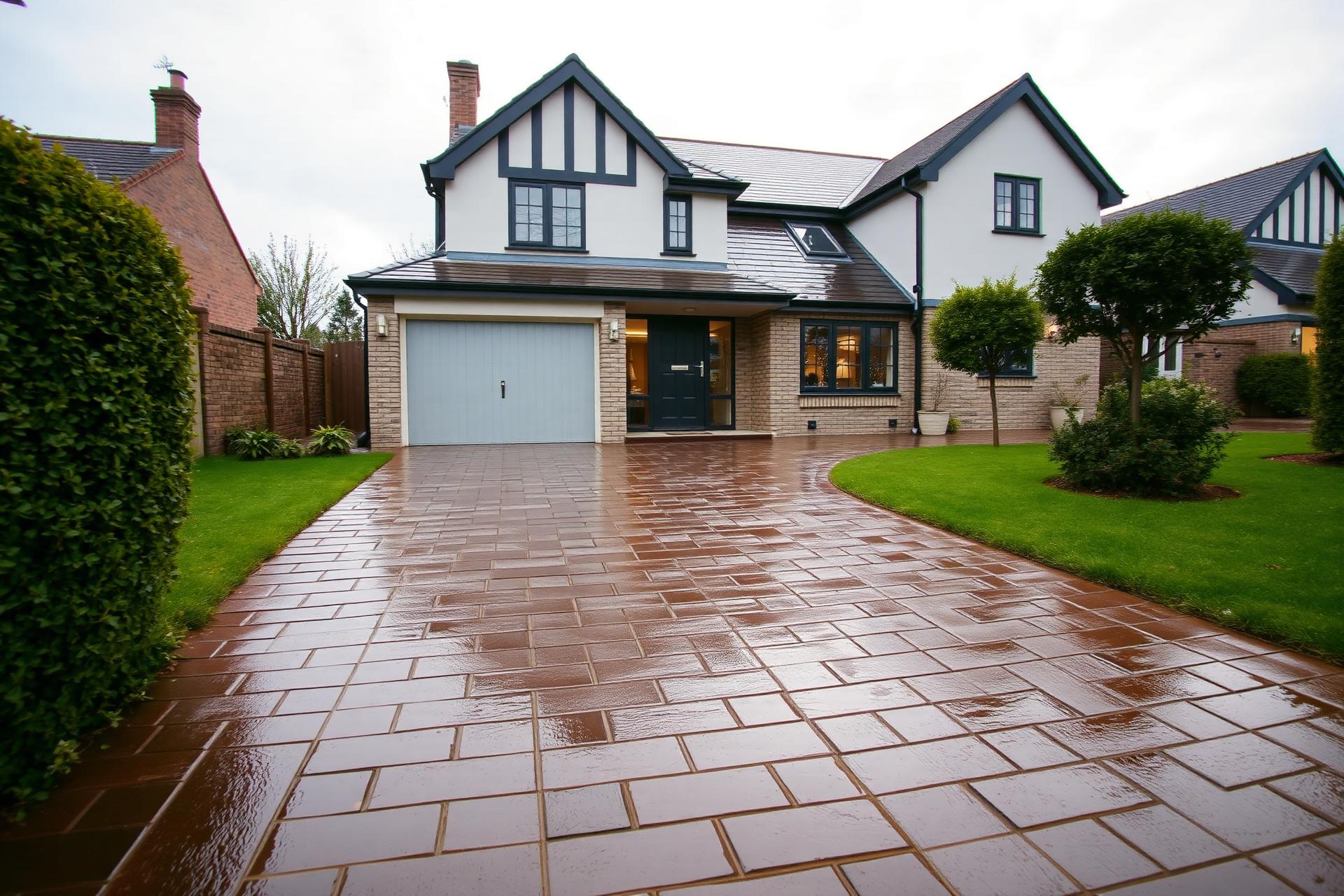
Pressure Washing for Steep Stone Driveways in Baildon
Steep stone driveway off Hoyle Court Road with moor grit ingrained in the surface
Properties climbing away from Browgate toward Hoyle Court Road sit on a noticeable slope, and that gradient changes how a driveway ages. Rain doesn't just sit and soak in the way it might on a flat Shipley yard — it runs, carrying fine peat grit and pollen off Baildon Moor down across the stone before pooling at whichever low corner the original layer chose.
Why Hoyle Court Road drives wear differently to the valley below
Properties climbing away from Browgate toward Hoyle Court Road sit on a noticeable slope, and that gradient changes how a driveway ages. Rain doesn't just sit and soak in the way it might on a flat Shipley yard — it runs, carrying fine peat grit and pollen off Baildon Moor down across the stone before pooling at whichever low corner the original layer chose.
Many of these driveways were laid decades ago in stone-built terrace plots and moor-edge detached gardens, using flags or setts that have since been repointed piecemeal. That patchwork of old and newer jointing means a pressure washer has to be handled with real judgement, because some sections will take a strong jet and others will lift straight out if you're heavy-handed near the edges.
The result of the moor-side wind is a fine grey bloom that settles into the pores of pale sandstone particularly fast here compared with more sheltered streets lower in town.
Points worth knowing before booking
Before we start
- Book outside heavy rain weeks — a sloped drive sheds water fast, so a dry spell gives the cleanest result.
- Expect a visible tide line at the lowest point until the whole drive dries evenly.
- Cars will need to be off the drive for the working section, not just the whole day.
Once it's done
- Wind off the moor can carry spray further than usual, so we take extra care near parked cars and paintwork.
- A re-sand of open joints afterwards helps stop the next batch of grit washing straight back in.
How the visit runs on a hillside drive
- Step 1
Working uphill in sections
We clean from the bottom of the slope upward in manageable bands, so dirty water is always moving away from areas already finished rather than back across them.
- Step 2
Pressure matched to each surface band
Sound flags near the top get a firmer setting; softer, older jointing lower down is cleaned at reduced pressure with more dwell time instead of raw force.
- Step 3
Final rinse timed with the gradient
The last pass follows the natural fall of the drive so we're not fighting the slope, which keeps the finish even rather than streaky near the low point.
Getting kit in, getting water away
Most of these drives are single-vehicle width with a turning apron near the garage, so we work the machine and hose reel around a parked car rather than asking anyone to move it into the road on a blind bend. Where a drive shares an entrance with a neighbour, we agree access times before starting so nobody's gate is blocked mid-clean.
Run-off on a sloped drive heads for whichever gully sits at the bottom of the pitch, usually tucked against a kerb line rather than a dedicated soakaway. We check that gully is clear before starting, because a blocked one on a hill sends dirty water straight onto the pavement rather than away underground.
- Postcode district
- BD17
- Local authority
- City of Bradford MDC
- County
- West Yorkshire
- Main route in
- A6038
- Nearest city
- Bradford — 4 miles
- Typical surfaces
- Yorkshire stone flags and older buff sandstone
Reading the stone before the machine goes near it
Jointing condition on the lower third
The bottom of a sloped drive takes the most standing water, so mortar or sand joints there are checked first for softness before any high-pressure pass.
Grit embedment versus surface algae
Moor grit sits differently to green algae — we test a small patch to see whether it lifts with hot water alone or genuinely needs mechanical agitation.
Edge stability near the boundary wall
Stone-built terraces often have low dry-stone or rendered boundary walls; we check these aren't already loose before working a jet close to them.
Scope agreed before anything is switched on
- We survey the surface first and say plainly if pressure washing is the wrong call for it.
- Scope is written down, so you can see exactly what is and isn't included.
- Where a stain or defect won't fully clear, we say so before you book.
See how we approach related surfaces and property types elsewhere in Baildon.
Questions we get asked on this stretch of Baildon
Will the slope make the job take longer?+
Usually a little, yes — working in bands uphill takes more care than a flat yard, so we allow extra time rather than rush the lower jointing.
Does moor grit actually stain the stone?+
It's more embedding than staining; fine peat particles work into open pores over time, which is why periodic cleaning keeps pale stone looking even rather than patchy.
Can you avoid disturbing the boundary wall?+
Yes — we check wall condition first and keep pressure directed onto the drive surface rather than straight at any loose stonework.
What happens to the dirty water?+
It follows the existing fall to the roadside gully, which we confirm is clear beforehand so nothing backs up onto the pavement.
The short version
A sloped Baildon driveway needs a banded, gradient-aware clean rather than a single flat-out pass.