
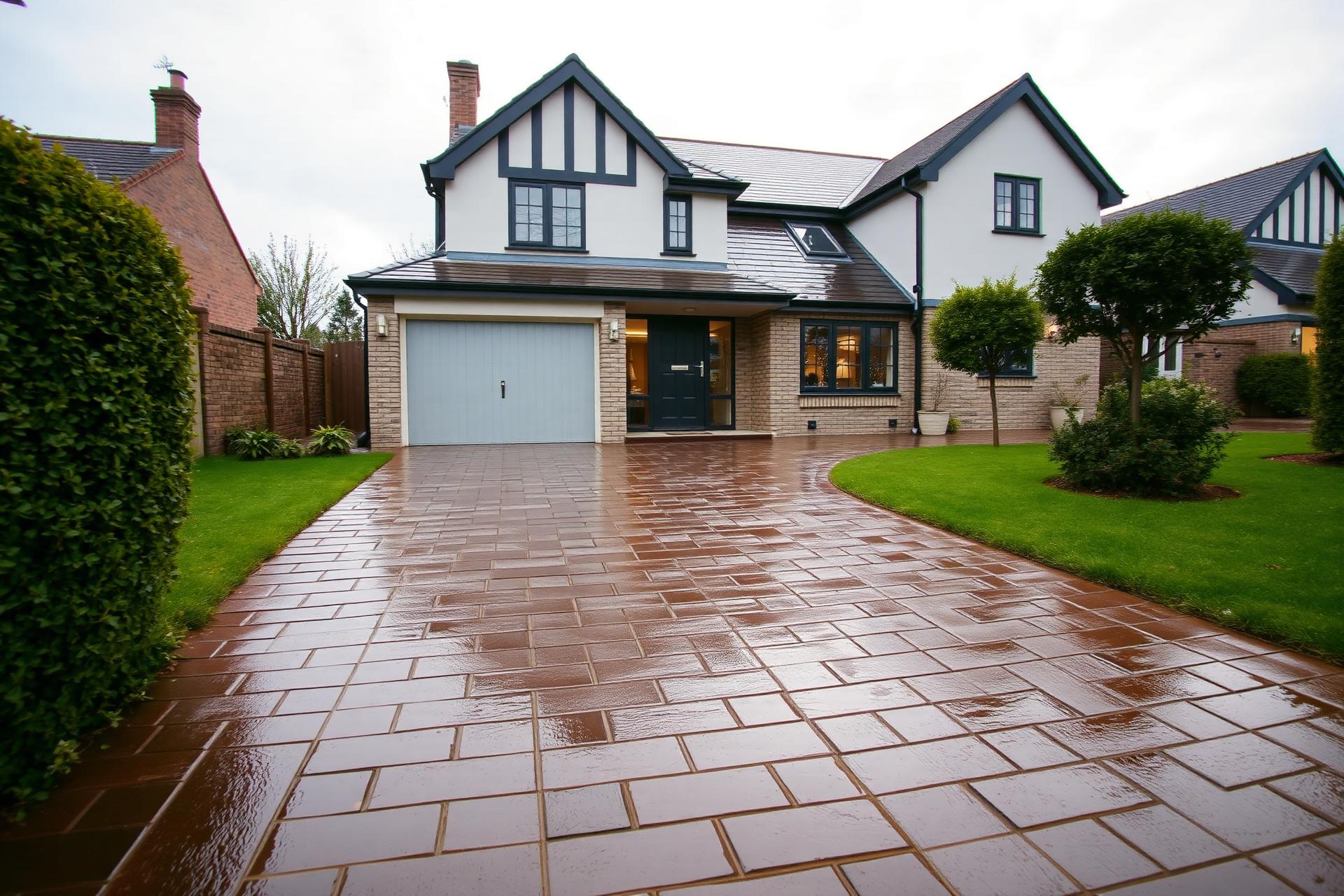
Driveway Care for Wakefield New-Build Estate Homes
New-build cul-de-sac with shared visitor parking bays and communal landscaped edges
Newer estate developments around Wakefield are typically laid out with shared visitor parking bays, communal landscaped verges and driveways finished in either block paving or imprinted concrete rather than traditional flagged stone.
What's different about cleaning a driveway on a new-build estate
Newer estate developments around Wakefield are typically laid out with shared visitor parking bays, communal landscaped verges and driveways finished in either block paving or imprinted concrete rather than traditional flagged stone.
Because these estates are recent, the surfaces themselves are usually in good structural condition, but the jointing sand and surface sealants applied at construction are only a few years old at most, which changes what a cleaning visit actually needs to address.
Shared visitor bays sitting close to private drives mean it's not always obvious where one household's responsibility ends, which matters when deciding what gets cleaned and what doesn't.
Things specific to newer developments
Before we start
- Confirm the private drive boundary with neighbours if it borders a shared visitor bay
- Construction-stage sealant, if still present, changes the right cleaning approach
- Newer block paving may still be settling, so joint sand needs regular checking
Once it's done
- Estate management rules sometimes affect what's allowed on communal-adjacent areas
- A first clean on a new-build drive is often lighter work than an older, more weathered one
How a new-build estate visit is planned
- Step 1
Boundary-confirmed working area
The agreed private drive area is worked within cleanly, with any adjoining shared bay left untouched unless separately agreed.
- Step 2
Sealant-aware pressure settings
If original construction sealant is still present, pressure and detergent choice are adjusted so the clean doesn't strip protection that's still doing its job.
- Step 3
Joint sand check and top-up
Where cleaning has revealed thinning joint sand, a top-up is offered as part of the visit rather than left for a future problem.
Getting kit in, getting water away
Visitor bays and open-plan verges mean there's rarely a fence or gate to navigate, but agreeing the exact boundary of the drive with the homeowner beforehand avoids any confusion with a shared parking area right next to it.
New-build drainage is usually engineered with a clear fall toward a formal gully or channel drain rather than relying on informal ground soakage, so run-off during cleaning is generally straightforward to direct sensibly.
- Main route in
- M1 J40 / A638
- Nearest city
- Leeds — 10 miles
- Typical surfaces
- sandstone flags and clay-red block paving
- Common property stock
- stone-built terrace, 1970s estate home, commercial forecourt
- Nearest commercial hub
- Wakefield Europort and Trinity Walk
- Area type
- city
What's checked on a newer estate drive
Original sealant status
We check whether the drive still carries its construction-stage sealant and how much protection is left, since that affects whether a clean alone is enough or a reseal is also worth considering.
Jointing sand settlement
Newer block paving can still be settling in its early years, so joint sand levels are checked before any high-pressure work near the edges.
Shared bay boundary
Where a visitor bay sits adjacent to the drive, we clarify with the homeowner exactly where the private surface ends before starting.
Scope agreed before anything is switched on
- We survey the surface first and say plainly if new-build estate homes is the wrong call for it.
- Scope is written down, so you can see exactly what is and isn't included.
- Where a stain or defect won't fully clear, we say so before you book.
Block paving sealing and imprinted concrete sealing pages cover the surface-specific care these estates need.
Questions from new-build estate residents
Does a new-build drive need cleaning as urgently as an older one?+
Less urgently in the first couple of years, but jointing sand and any original sealant still benefit from regular checking rather than being left untouched.
Who's responsible for cleaning the shared visitor bay next to our drive?+
That's usually a matter for the estate's management arrangements rather than an individual household, so we only work within the confirmed private boundary.
Will cleaning strip the sealant put down when the drive was built?+
We check for it first and adjust pressure and product accordingly so we're not undoing protection that's still working.
Is imprinted concrete or block paving easier to maintain on a new estate?+
Both hold up well when new; the main difference over time is that imprinted concrete relies on a surface colour layer while block paving's main upkeep is jointing sand.
The short version
New-build estate drives in Wakefield need boundary-aware, sealant-conscious cleaning that respects shared visitor bays and still-settling jointing sand.