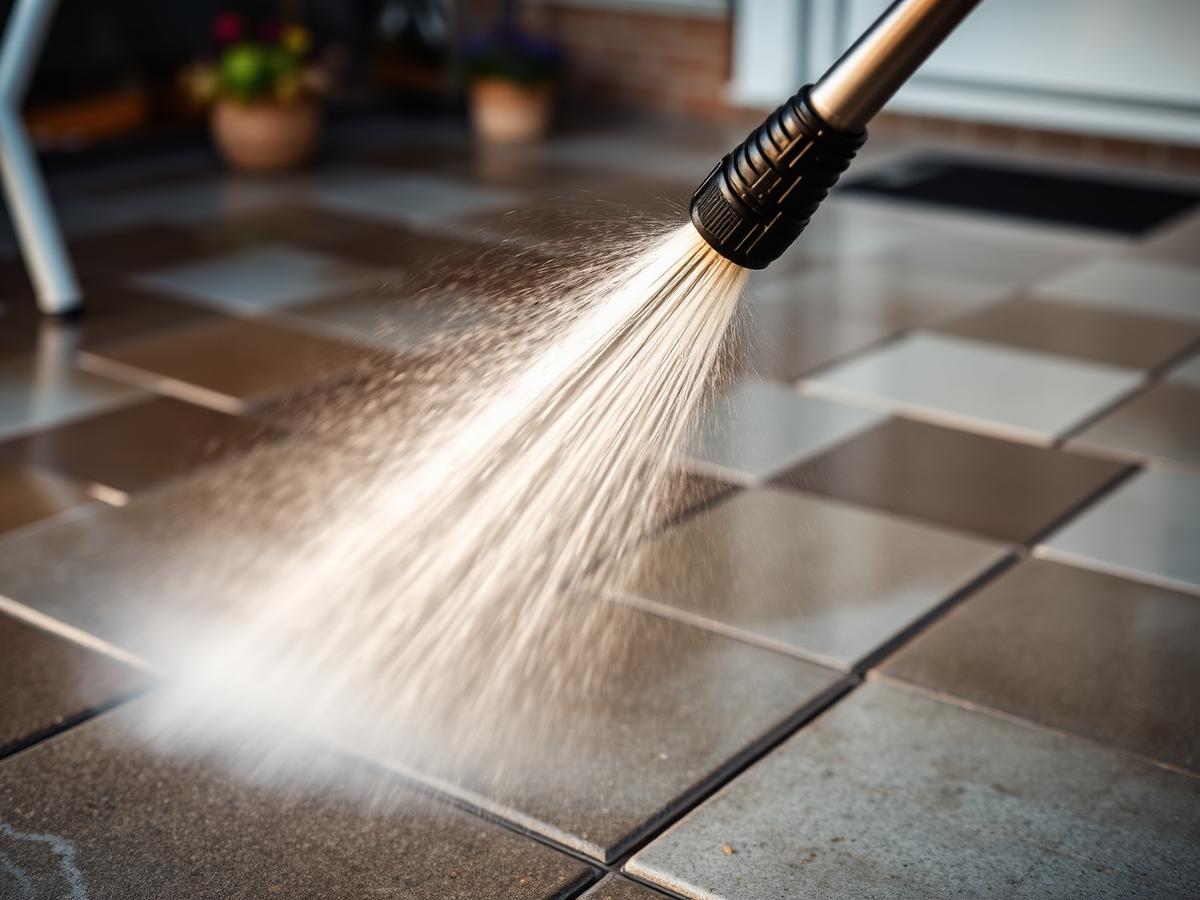
Almost every homeowner has access to a pressure washer of some kind, and the temptation to save money by doing the drive or patio yourself on a Saturday morning is understandable. The equipment gap between a domestic machine and a professional rotary setup is real, but it's not the only difference that matters.
This isn't about discouraging DIY entirely — light, regular upkeep with a domestic machine has its place. It's about being clear on where the two approaches genuinely diverge, so expectations match the tool being used.
Equipment differences that show up in the result
- Domestic lances concentrate pressure into a narrow jet, which is exactly what causes the striping pattern often seen on DIY-cleaned drives.
- Professional rotary flat-surface cleaners spread pressure evenly across a rotating head, which is why professionally cleaned surfaces come out uniform rather than banded.
- Domestic machines are usually lower flow and lower pressure overall, meaning longer dwell times are needed to shift the same growth.
- Professional setups can pair pressure work with dedicated biocide dosing equipment, rather than a hand-sprayed treatment.
Chemical treatment is the part most DIY jobs skip
A pressure wash alone strips visible growth off the surface but rarely kills the root structure of algae, moss or lichen. Without a biocide treatment applied and given time to work, that growth tends to return within a matter of months rather than years.
Sourcing and dosing biocide correctly isn't difficult in principle, but it's a step that's easy to skip when the drive already looks clean after a wash — and it's usually the reason a DIY clean doesn't last as long as expected.
Surface risk is easy to underestimate
Close-range pressure on the wrong setting can etch softer stone, blow jointing sand out of block paving in one pass, or strip a sealer unevenly. A professional operator is judging pressure and distance constantly based on the material in front of them.
The risk isn't that DIY always causes damage — plenty of careful DIY cleans go fine — it's that the margin for error is narrower than it looks, particularly on natural stone or older, already-worn surfaces.
Where DIY genuinely makes sense
Light, regular rinsing between professional treatments — clearing leaves, loose debris and general dust — is a reasonable job for a domestic machine and helps keep the surface looking fresher for longer.
The professional clean earns its place for the deeper, root-level work: biocide treatment, even rotary cleaning, and joint re-sanding, which together tend to hold results for longer than a wash alone.
Surfaces where DIY is usually fine
- Small concrete paths and steps with light surface algae.
- Rinsing a porcelain patio that just needs the winter film off.
- Keeping on top of a surface that has already been professionally cleaned and re-sanded.
Surfaces worth thinking twice about
- Imprinted concrete — the colour and sealer are the surface, and a domestic lance strips both.
- Resin-bound — dislodged aggregate can't be put back.
- Old or riven natural stone with soft or lime pointing.
- Softwood decking, where a lance raises and tears the grain.
- Any large block-paved drive, because stripping the joint sand means re-sanding the whole area properly afterwards.
The three mistakes that cost the most
First, cleaning without treating: the green comes back by the following season because the biology was never killed.
Second, striping. A hired lance on a large open surface almost always bands, and it's very visible from a first-floor window.
Third, sand loss. Blasting joints out of block paving is quick and easy; getting those joints properly refilled and settled is neither.