
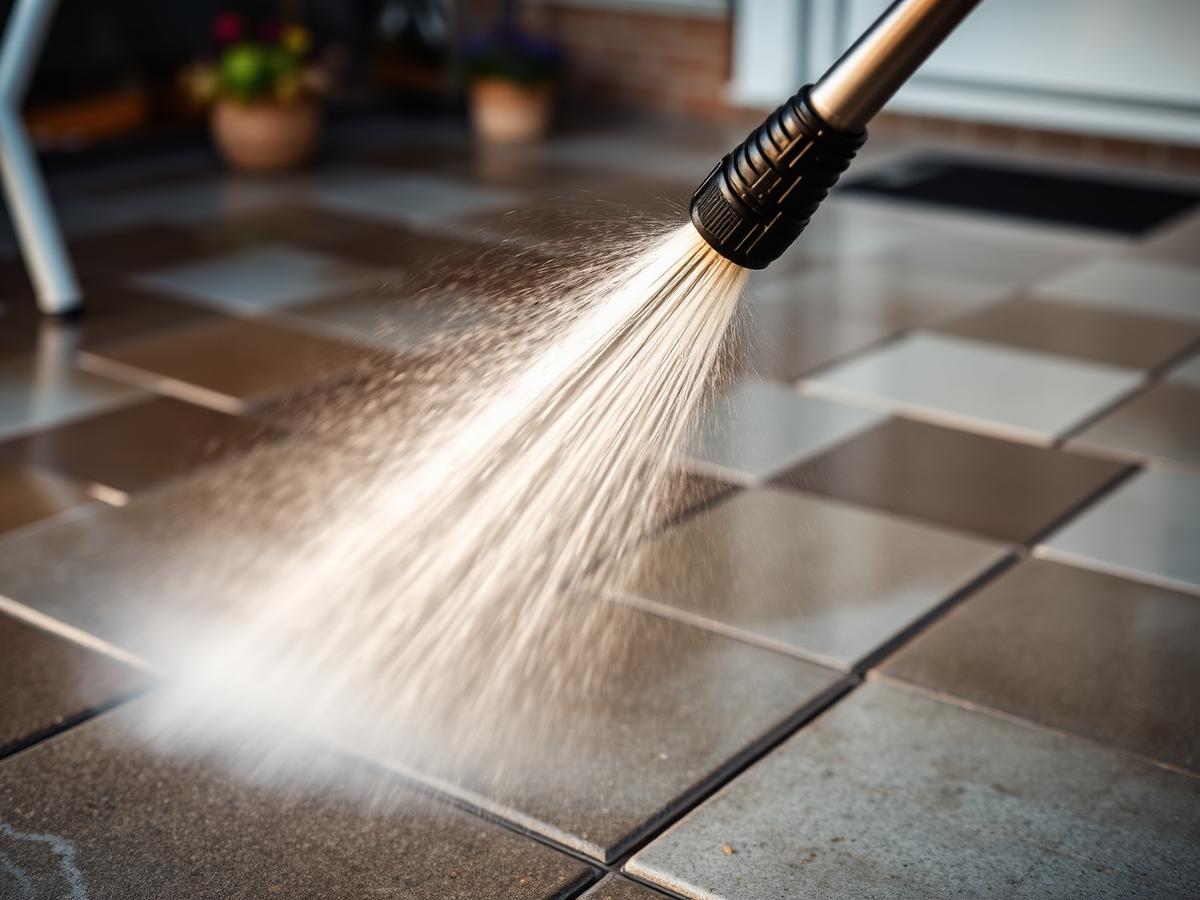
Pressure washing uses mechanical force to remove what's on a surface. Soft washing uses low pressure plus a chemical treatment to kill and lift growth without force. Both are legitimate. Using the wrong one is what ruins surfaces.
Pressure washing suits
- Block paving and concrete flags, using a rotary flat-surface cleaner for even coverage.
- Tarmac at controlled pressure — enough to lift moss, not enough to strip the binder.
- Commercial forecourts and delivery yards with oil, grease and gum.
Soft washing suits
- Indian sandstone and other porous natural stone with black spot lichen.
- Old Yorkshire stone flags, particularly where pointing is lime-based or already failing.
- Timber and composite decking, where a lance will fur the grain and cut the board.
- Imprinted concrete and resin-bound drives, where the surface layer is the finish.
What going in too hard actually does
On imprinted concrete it strips the colour hardener and the sealer, leaving a patchy grey surface that then needs re-colouring — a far bigger job than the clean was.
On resin-bound it dislodges aggregate and opens the matrix. On softwood decking it raises the grain so the board feels rough and holds dirt worse than before. On old stone it erodes the face and blows out the pointing.
None of that shows immediately, which is why cheap, fast, high-pressure work looks great on the day and poor a year later.
Choosing by what the patio is made of
Dense, factory-made materials like porcelain and modern concrete flag can generally take a firmer pressure wash because the surface is uniform and the wearing layer is thin but tough. Older, riven or hand-laid stone is the opposite: the surface is soft, uneven, and any weak or flaking layer gets removed along with the dirt if you push too hard.
The tell is usually visible before you start. Chalky, powdery stone, worn lettering on reclaimed setts, or crumbling arris edges on old flags are all signs that a lance at close range will do more damage than the moss ever did.
The judgement call is less about the material family and more about condition: a twenty-year-old block-paved drive with sound, unworn blocks is a different case from the same drive after a decade of being pressure-washed too aggressively every spring.
Mixing the two on one job
Most patios aren't cleaned with a single method start to finish. It's common to soft-wash the open stone while lancing hard-wearing edges, steps or a concrete apron with more force, because those areas can take it and benefit from the extra speed.
The point isn't to pick a side in a soft-wash-versus-pressure-wash argument — it's to apply each where the material actually calls for it.