
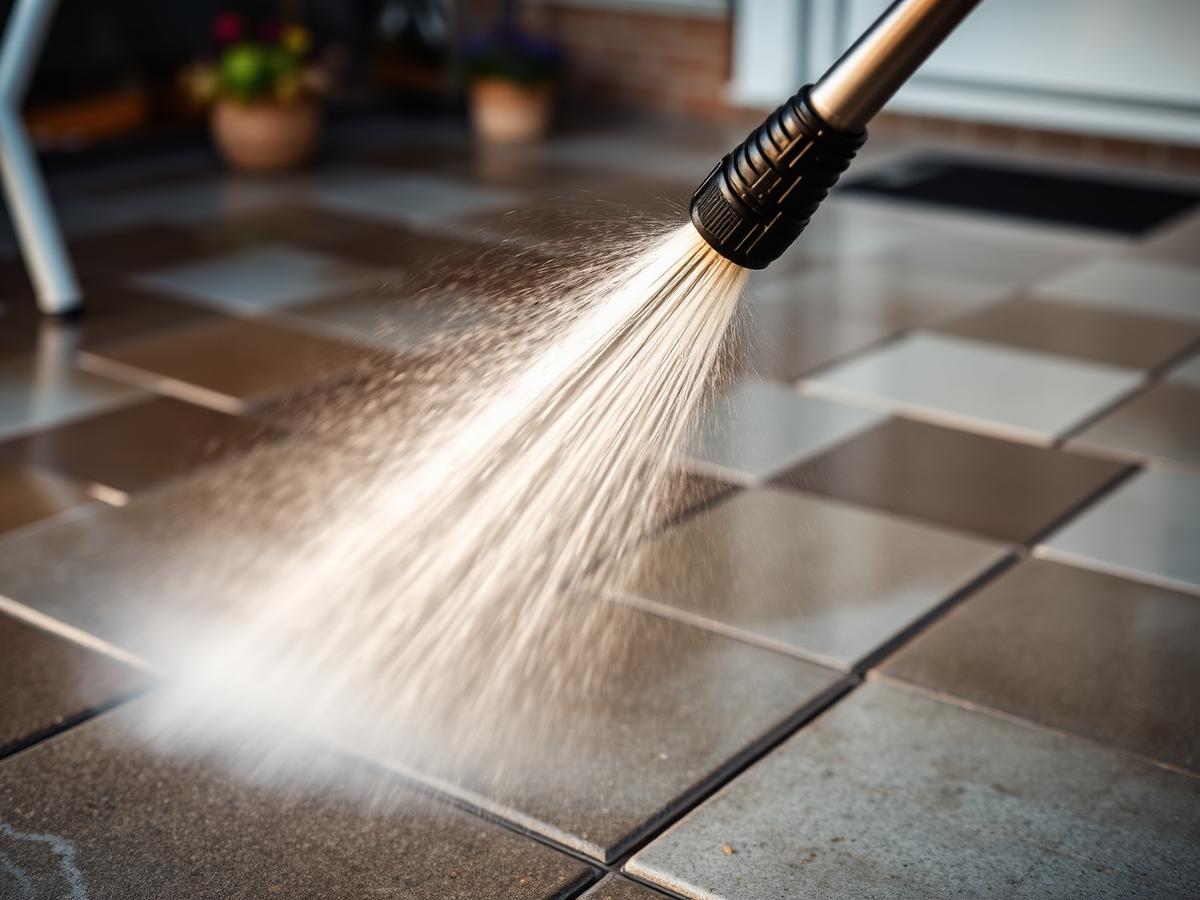
Every autumn we get calls about brown shadows on patios and drives that appeared without explanation. They are almost always tannin stains — the mark left where a wet leaf sat on porous paving for a fortnight and leached its pigments into the surface.
Tannins are natural plant compounds, and they behave more like a dye than like dirt. That is why a general wash often fails to shift them and why treating them needs a slightly different approach. It is also why prevention, in the form of a broom and ten minutes a week, is so disproportionately effective.
Why leaves stain, and which ones are worst
A wet leaf pressed against porous paving forms a poultice in reverse: as it decomposes, tannins and other pigments leach out and are drawn into the pores of the stone or concrete. On a smooth, non-porous surface such as porcelain, almost nothing happens. On sandstone, concrete flags or block paving, the mark can be surprisingly persistent.
Oak, beech, sycamore and horse chestnut are among the more troublesome, being both high in tannin and inclined to lie flat and stay wet. Small leaves that pack into joints cause a different problem — less staining, more organic debris feeding weeds and algae.
Fruit and berry drop is worse again in the short term. Cherry, elderberry and pyracantha berries produce vivid stains that are effectively fruit dye on stone.
The prevention that beats every treatment
- Sweep weekly through leaf fall — this is the single highest-value maintenance habit for exterior surfaces.
- Do not let a leaf mat build up in a shaded corner over winter; that is where the worst staining and growth appear.
- Clear joints as well as the surface, since packed leaf debris in a joint becomes next year's compost and seedbed.
- Keep gutters and gullies clear so decomposing leaf matter is not carried across the paving in every downpour.
- Move planters and furniture periodically so leaves cannot accumulate underneath unnoticed.
- Consider trimming overhanging branches where a specific tree is the repeat offender.
Removing established tannin stains
Start with the mildest approach: a thorough wash with a suitable exterior cleaner and a stiff brush. On block paving and concrete this alone often lifts a good proportion of a recent mark.
Where the stain persists, an oxygen-based or percarbonate cleaner is the more effective route. These work by oxidising the organic pigment rather than scrubbing it off, which is exactly what a dye-type stain requires. They need dwell time, and they work better on a warm day.
Avoid reaching for acid. Acidic cleaners are not the right chemistry for organic tannins, and on limestone, lime-based pointing and some sandstones they will etch the surface and leave you with a worse and permanent problem.
For deep marks in porous stone, a poultice works: mix the cleaner with an absorbent powder into a paste, apply thickly over the mark, cover, and let it dry slowly so it draws the pigment back out. Repeat applications are normal.
Surface-by-surface notes
- Indian sandstone: highly susceptible and the marks go deep. Low pressure, oxygen-based chemistry and patience.
- Concrete flags and block paving: fairly tolerant of treatment, and most tannin marks respond to an oxidising cleaner.
- Porcelain: rarely stains at all — anything visible is usually residue sitting on the surface and washes off easily.
- Tarmac: dark enough that tannin staining is rarely noticeable; the leaf problem here is moss growth under leaf mats.
- Resin bound: leaf debris clogs the pores, so the priority is flushing drainage rather than removing colour.
- Decking: tannin marks are common and should be treated along the grain, with care not to raise the fibres.
The wider autumn checklist
Autumn is the last practical window for meaningful outdoor work before conditions close in, and what you do now decides how bad spring looks. Alongside the sweeping, clear all drainage properly and check it actually runs, because a gully that blocks in October produces standing water for the whole winter.
Top up any jointing sand that has dropped, so joints shed water rather than hold it. If cracks in concrete or tarmac need sealing, do it now rather than after they have taken on water and been through a freeze.
A biocide treatment applied in autumn is often more useful than one applied in spring, because it goes on before the wettest, darkest months when growth would otherwise establish. It is a quiet, unglamorous job that makes the spring clean much easier.
Autumn versus spring cleaning
There is a reasonable case for both. A spring clean gives you a surface that looks its best for the season you actually use the garden. An autumn clean plus treatment protects the surface through the period that does the damage and leaves far less to remove in March.
For most Yorkshire properties under any real tree cover, the pragmatic answer is a proper clean in spring and a treatment plus thorough sweep in autumn. That combination costs less than two full cleans and delivers better results than either alone.