
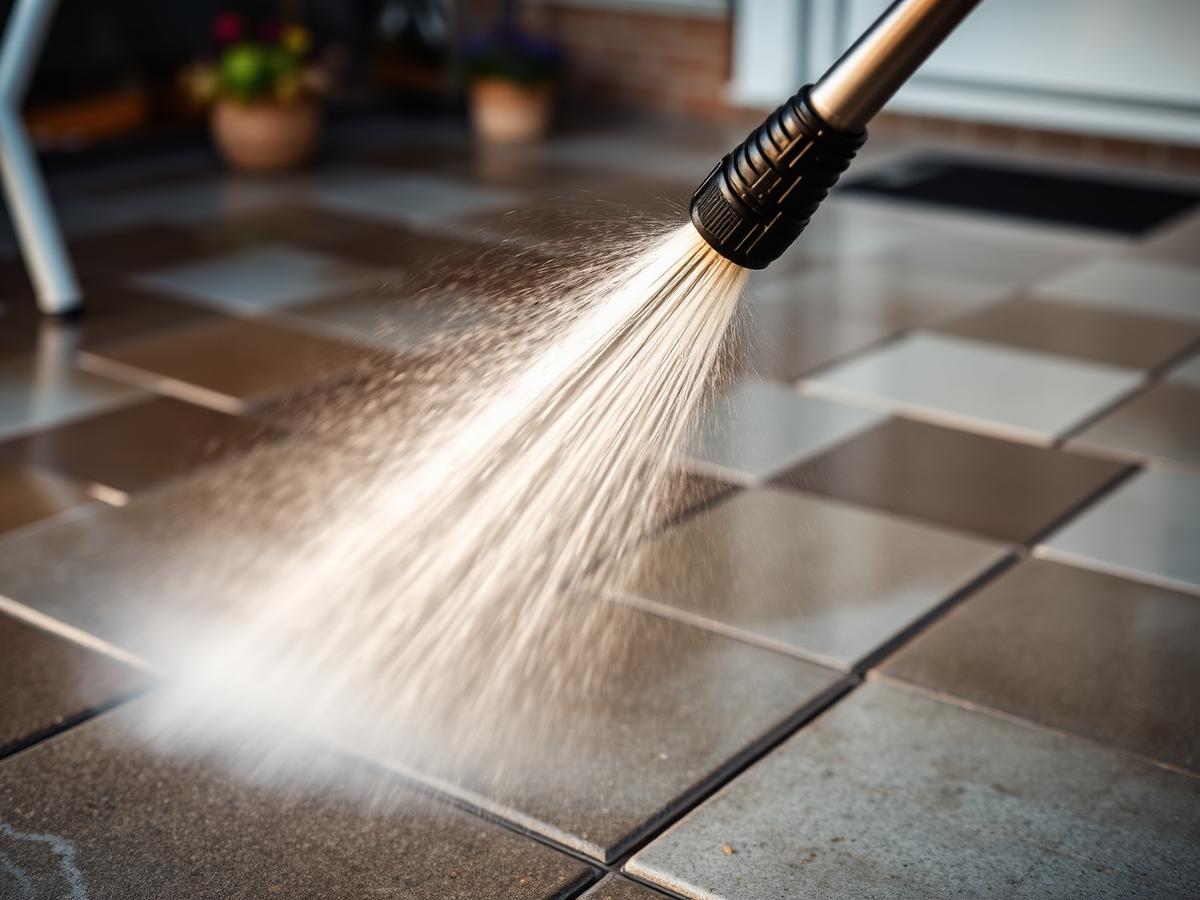
The single most common thing we are called out to fix is not dirt — it is the result of someone cleaning enthusiastically. Zebra striping, scoured patches, blown-out joints and etched flags are all the fingerprints of too much pressure applied for too long in one place.
This guide sets out how professional exterior cleaning actually works, so that if you are doing it yourself you avoid the expensive errors, and if you are hiring someone you can tell within thirty seconds whether they know what they are doing.
Chemistry first, pressure second
Green and black growth on paving is living. Blasting it off removes what you can see and leaves the root structure sitting in the pores and joints, which is exactly why a drive that was spotless in April is green again by September. A biocide applied first, left to dwell, and allowed to work is what actually kills it.
The correct order is: clear the surface, apply the treatment, let it dwell, then wash. Washing first and treating afterwards is largely wasted product, because you have already removed the material the treatment needed to penetrate.
Dwell time is not optional and it is not five minutes. This is the stage that separates a clean that lasts from a clean that photographs well for a fortnight.
Use the right tool for the open surface
- A rotary flat-surface cleaner is the correct tool for the main field of any paving. It spreads the load, keeps a fixed distance from the surface, and produces an even finish with no striping.
- A lance is a detail tool: edges, steps, corners, awkward returns and around drainage — not the whole drive.
- A turbo or rotating pencil nozzle concentrates enormous energy into a tiny spot. It has a place on stubborn concrete, and no place at all on sandstone, tarmac, resin or imprinted concrete.
- A soft wash setup — low pressure, correct chemistry — is right for delicate or coated surfaces where mechanical force would do damage.
Technique that prevents striping
Striping happens when passes do not overlap and the machine dwells unevenly. Overlap every pass by roughly half its width, keep a constant walking speed, and never stop moving while the trigger is down. If you must pause, release the trigger first.
Work in consistent directions across a full run rather than in patches. Cleaning half a drive today and half next weekend almost always leaves a visible seam, because the two halves weather differently in the interval.
Keep the nozzle at a consistent distance. Every centimetre closer sharply increases the energy hitting the surface, which is why hand-held lance work is so hard to keep even over a large area.
Rinse in the direction of the fall, and rinse more thoroughly than feels necessary. Residual slurry that dries on the surface is the cause of most 'it looked great when wet' disappointment.
Surfaces that need caution or a different approach
- Indian sandstone: soft and layered — too much pressure delaminates the face and it never recovers. Lower pressure, more chemistry.
- Imprinted concrete: the pattern is a thin coloured surface layer. Aggressive washing takes the colour off, and once it is gone it needs resealing to restore.
- Resin bound: pressure knocks stones out of the matrix. Wide fan, gentle, focus on flushing the pores.
- Tarmac: force lifts fines and opens the surface. Keep the machine moving constantly.
- Old lime-pointed stone: the pointing is softer than the stone and will be washed out before you notice.
- Decking: always work along the grain and at low pressure, or you raise the fibres and get a permanently furry board.
Practical mistakes that cost real money
- Jet washing block paving and not re-sanding afterwards — the joints are structural, and empty joints let blocks move.
- Washing towards the house rather than away from it, and driving slurry under a door threshold or into an airbrick.
- Forgetting to check where the run-off goes; silt into a garden border or a neighbour's drive causes more disputes than any other part of the job.
- Cleaning in strong direct sun, so chemistry dries before it can work and the surface dries in patches.
- Working in freezing conditions and forcing water into joints that then freeze and lift blocks.
- Sealing on the same day as cleaning, before the surface has dried through.
Safety and the boring but important bits
Pressure washers cut skin easily and the injury looks trivial while being anything but. Never point a lance at anyone, wear eye protection, and use sturdy boots — the recoil on a rotary nozzle can catch you out on a wet slope.
Check your water supply before starting. Starving a pump causes cavitation and will destroy it faster than any amount of hard work. If you are hiring kit, ask what flow rate it needs.
Protect what you are not cleaning: cover light fittings, close windows, move planters, and mask anything painted that will sit within splash range. Cleaning up overspray takes longer than preventing it.