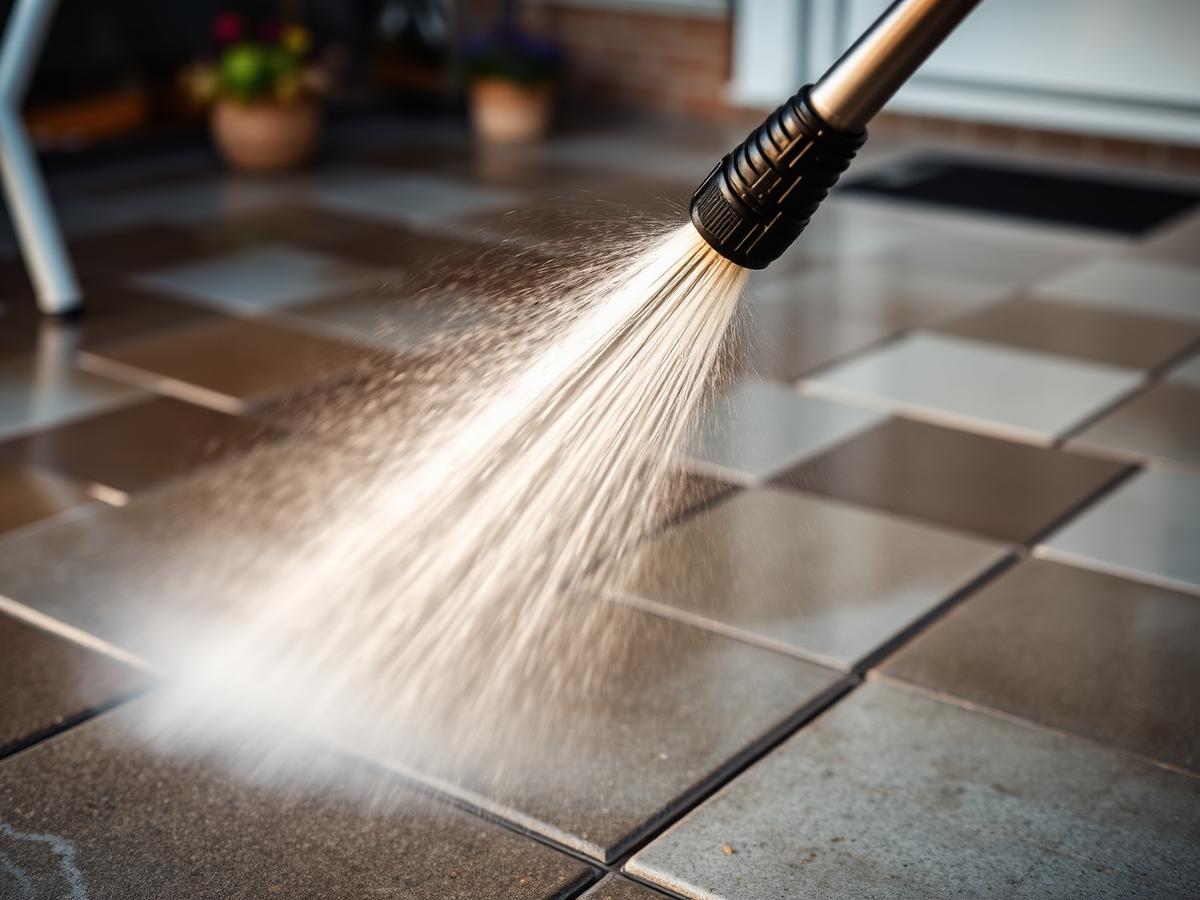
If you've seen a drive with faint parallel bands across it after cleaning, you've seen lance striping. It's a technique problem, not a dirt problem, and once it's in a porous surface it can take a long time to weather out.
What each tool does
- A rotary flat-surface cleaner spins jets under a shroud at a fixed height, so every square inch gets equal dwell and equal distance.
- A hand lance concentrates a narrow, high-energy jet at whatever distance and angle the operator holds it.
Why the lance stripes
Held by hand, the jet cleans more aggressively at the centre of its arc and less at the edges, and the operator's speed varies constantly. The overlap between passes gets cleaned twice, the far edge of each pass barely once.
On uniform surfaces such as block paving and concrete, that difference is immediately visible as banding. On heavily soiled surfaces it can even etch the surface where it lingers.
Where the lance is the correct tool
- Edges, kerbs, steps and the last 100mm against walls where the rotary can't reach.
- Detailing around gullies, drain covers and awkward returns.
- Targeted work on a specific stain, at controlled pressure.
- Rinsing down surrounding areas at the end of the job.
The combination most jobs actually need
A well-run clean uses the rotary head for the main open expanse and switches to the lance for the border — roughly the last foot against walls, fences and features — plus any detailing the rotary head physically can't reach.
The shroud on a rotary head also contains spray and splashback, which matters where the work runs close to windows, planting or parked cars. Choosing one tool for the whole job, out of habit or to save time, is usually where a poor finish comes from rather than the equipment itself.